
PEPTIDES BIO / MATERIAL RECORD
BPC-157 / TB-500 / GHK-Cu (Glow) 70mg
Research-use peptide material record: pack format, specifications and COA/SDS request for qualified laboratory review.
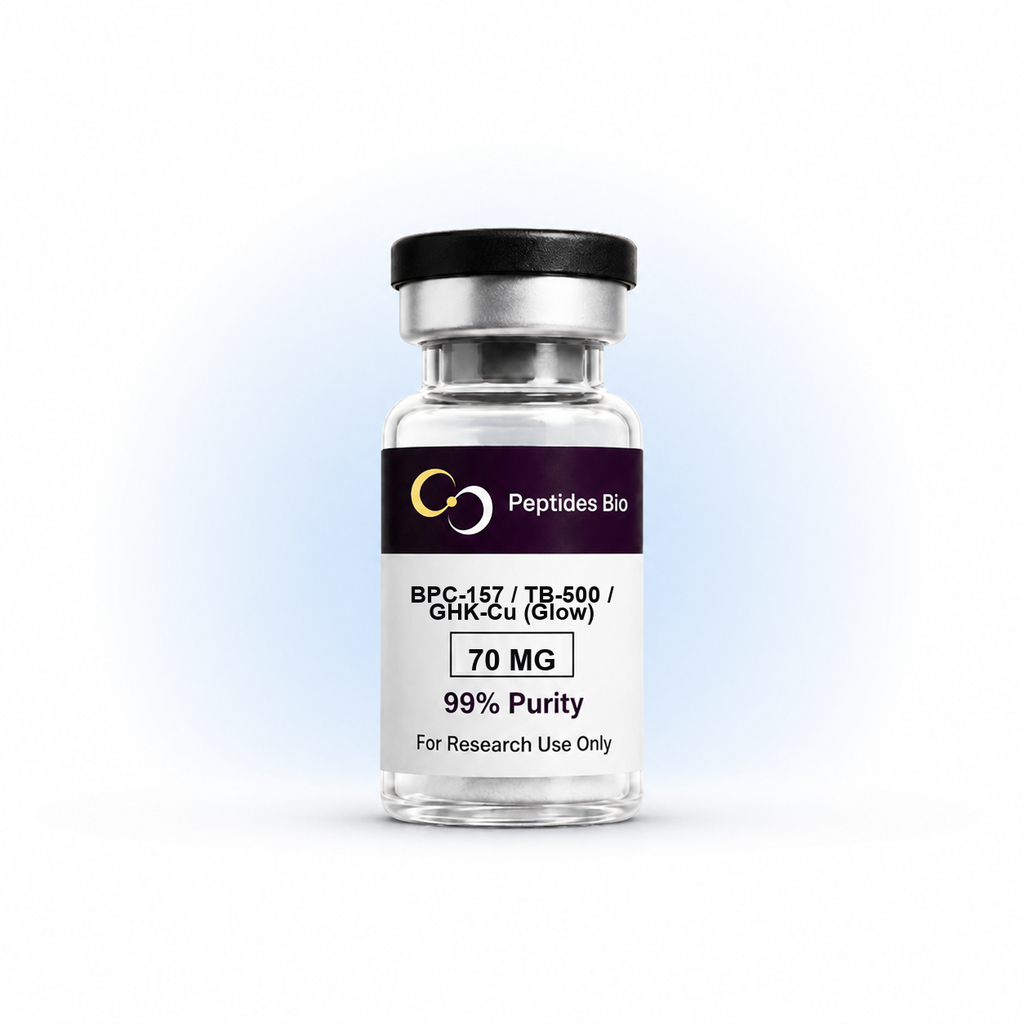
BPC-157 / TB-500 / GHK-Cu (Glow) 70mg
Volume pricing
Configured totals update at each quantity threshold.
Request COA / MSDS
Research record
Pending manual confirmationResearch overview
The triple-peptide combination of BPC‑157, TB‑500, and GHK‑Cu—often referred to as the “Glow Protocol” or “Wolverine Stack”—is currently one of the most prominent systemic regenerative regimens in peptide research. Its three components act through complementary and overlapping pathways, addressing tissue repair at multiple levels: cellular regeneration, angiogenesis, and inflammatory modulation. BPC‑157 is a synthetic 15‑amino‑acid polypeptide derived from human gastric juice. Its primary actions include: promoting angiogenesis via the VEGFR2‑Akt‑eNOS pathway; enhancing fibroblast activity and collagen synthesis; facilitating cell migration and adhesion through FAK‑paxillin signalling; and modulating nitric oxide and various neurotransmitter systems. These effects translate into accelerated healing of muscle, tendon, ligament, bone, and gastrointestinal tissues. TB‑500, the active fragment of natural thymosin β4, operates by: binding to G‑actin to reorganise the cytoskeleton and promote cell migration; upregulating VEGF to stimulate neovascularisation; modulating cytokine profiles to curb inflammation; and inhibiting the Akt pathway, thereby exerting anti‑fibrotic activity. GHK‑Cu is a naturally occurring tripeptide‑copper complex first isolated from human plasma. Its distinctive role lies in deep gene‑expression regulation—it influences thousands of human genes, stimulates fibroblast production of collagen, elastin, and glycosaminoglycans, suppresses inflammation via JAK1 pathway downregulation, reduces reactive oxygen species, and delivers copper ions directly to damaged sites to facilitate tissue remodelling. When combined, BPC‑157 establishes the angiogenic and gastroprotective foundation; TB‑500 enhances cell migration and matrix remodelling; and GHK‑Cu orchestrates collagen synthesis and antioxidant defence at the transcriptional level. Together, they form an integrated repair network spanning vascular, cellular, and genetic tiers—a synergy that has attracted extensive research interest in regenerative medicine and tissue repair.
Research reference
Product FAQ
What does the 70mg label describe?
It identifies the nominal total pack format for this three component research material. Confirm the component allocation, SKU and lot specific record before comparing results across batches.
Which components are listed in this material?
The product record lists BPC-157, TB-500 and GHK-Cu. Each component should remain separately identifiable in research notes and literature review.
Can single component literature be applied directly to the blend?
No. Evidence about one component does not establish the behavior of the combined material. Record the blend composition and evaluate each source according to the material actually studied.
Which documents should be requested for this pack?
Request the current lot identifier, composition record and available identity or purity documentation. Document availability is confirmed during the quotation process.
How should this material be recorded in a study file?
Use the complete product name, SKU, nominal pack size, lot number and the analytical documents supplied for that lot.
Data sheet
Manual confirmation- Material Type
- Blend
- Purity Identity
- ≥99% purity
- Molecular Weight
- 1419.5 g/mol/889.01 g/mol/401.91 g/mol
- Pack Size
- 70mg
- Molecular Formula
- C62H98N16O22/C38H68N10O14/C14H22CuN6O4
- CAS Number
- 137525-51-0/885340-08-9/89030-95-5
- PubChem CID
- 9941957/62707662/71587328
- Storage conditions overview
- Storage typeLong-termTemperature-80°CDuration2-3 yearsNotesSealed, dark, minimal openingStorage typeStandardTemperature-20°CDuration1-2 yearsNotesSealed, dark, moisture-proofStorage typeShort-termTemperature4°CDuration1-2 weeksNotesTemporary storage, use promptlyStorage typeWorking SolutionTemperature4°CDuration1-7 daysNotesReconstituted, short-term, avoid freeze-thaw