
Quality & Documentation
PEPTIDES BIO / MATERIAL RECORD
Cagrilintide 10mg
Research-use peptide material record: pack format, specifications and COA/SDS request for qualified laboratory review.
RESEARCH USE ONLYRUO
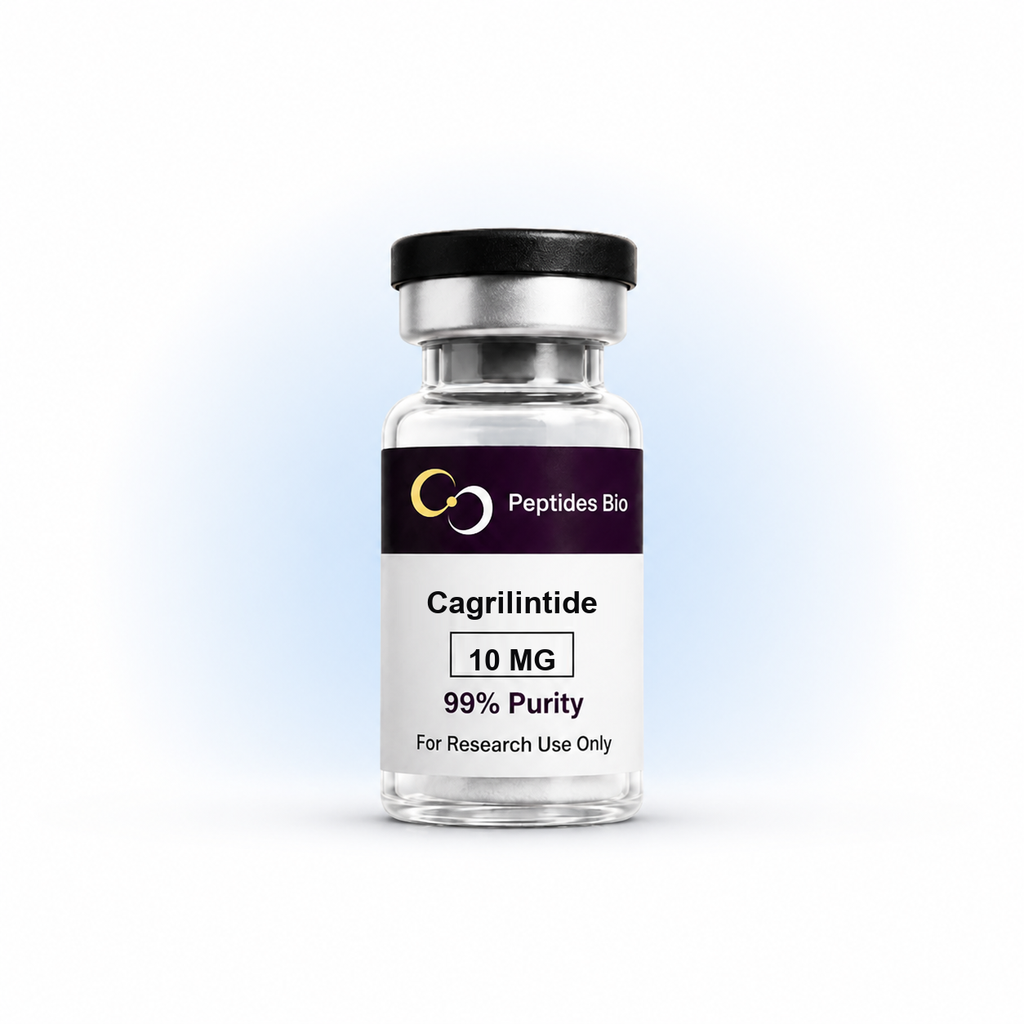
Cagrilintide 10mg
Important NoticeThis product is for use only in vitro research. It is strictly prohibited for human injection, clinical treatment, food addition or any animal experiments. Please read our terms and conditions carefully before placing an order.
Volume pricing
Configured totals update at each quantity threshold.
Configured total$69.35
Request COA / MSDS
Research record
Pending manual confirmationResearch overview
Cagrilintide 10mg research material is supplied for laboratory research use only. This record covers the current pack format, specification fields, and documentation workflow. Cagrilintide is a novel long‑acting acylated amylin analogue that functions as a dual agonist at the amylin receptor (AMYR) and the calcitonin receptor (CTR). Native amylin is a neuroendocrine hormone secreted by pancreatic β‑cells and plays a critical role in glucose homeostasis and energy balance. Its physiological effects include delaying gastric emptying, suppressing postprandial glucagon secretion, and promoting satiety. Cagrilintide overcomes the rapid clearance of native amylin through acylation modification. It acts via a multifaceted mechanism, involving binding to and activating amylin and calcitonin receptors in key brain regions involved in appetite control, such as the area postrema and the hypothalamus. Structural studies have revealed that Cagrilintide adopts a similar "side‑channel" binding mode at both AMY1R and CTR. Key molecular features include anchoring of the F23 residue within the receptor transmembrane bundle, an intramolecular salt bridge between E14 and R17 that stabilizes the helical structure, and interaction of the C‑terminal P37 with the receptor extracellular domain (ECD). Furthermore, cryo‑electron microscopy (cryo‑EM) structural analysis has provided detailed insights into Cagrilintide binding to Gs‑coupled active AMY1R, AMY2R, AMY3R, and CTR.
Research reference
Product FAQ
What is Cagrilintide?
Cagrilintide is a long‑acting analogue of pancreatic amylin. By mimicking the physiological actions of native amylin, it targets both the amylin receptor and the calcitonin receptor—hence its classification as a dual amylin and calcitonin receptor agonist (DACRA)—to regulate appetite and energy metabolism.
Unlike commonly used GLP‑1 receptor agonists (e.g., semaglutide), Cagrilintide acts through an independent pathway. Therefore, it may be used as a monotherapy or in combination with GLP‑1‑based agents to enhance weight‑loss efficacy.
What is the purity standard for Cagrilintide?
The purity of our Cagrilintide products is ≥99%. Each batch is independently tested by a third‑party laboratory using HPLC and mass spectrometry (MS), and a complete Certificate of Analysis (COA) is provided for each batch.
Is Cagrilintide used for treating humans?
No. The Cagrilintide sold on our website is a research-grade product, intended solely for use in in vitro laboratory research and not for human injection, clinical treatment, or any commercial applications. Cagrilintide is still in the clinical research stage and has not yet been approved for commercial use as a drug.
How should Cagrilintide be stored?
The freeze‑dried powder can be stored at room temperature (in its original packaging) for several days to several weeks. For long‑term storage, it is recommended to freeze at ‑20°C and protect from light. After reconstitution, it should be stored refrigerated (at 4°C) and should not be frozen.
What research areas is Cagrilintide used for?
Yes. Cagrilintide monotherapy produces a meaningful weight-loss effect (−12% at 68 weeks in REDEFINE-1) and is appropriate for amylin-· Obesity and weight management
· Type 2 diabetes and glycemic control
· Appetite and energy intake regulation
· Non‑alcoholic fatty liver disease (NAFLD)
· Cardiovascular risk factors (e.g., blood lipids, blood pressure)receptor mechanistic research. However, for most modern obesity research, the combination protocol is more representative of likely clinical deployment.
Data sheet
Manual confirmation- Material Type
- Single material
- Purity Identity
- ≥99% purity
- Molecular Weight
- 4409.01 g/mol
- Pack Size
- 10mg
- Molecular Formula
- C194H312N54O59S2
- CAS Number
- 1415456-99-3
- Amino Acid Sequence
- {Eicosanedioic acid-γ-Glu}-KCNTATCATQRLAEFLRHSSNNFGPILPPTNVGSNTP-NH2 (Disulfide bridge:Cys3-Cys8)
- PubChem CID
- 171397054
- Storage conditions overview
- Storage typeLong-termTemperature-80°CDuration2-3 yearsNotesSealed, dark, minimal openingStorage typeStandardTemperature-20°CDuration1-2 yearsNotesSealed, dark, moisture-proofStorage typeShort-termTemperature4°CDuration1-2 weeksNotesTemporary storage, use promptlyStorage typeWorking SolutionTemperature4°CDuration1-7 daysNotesReconstituted, short-term, avoid freeze-thaw
Related research guides
Review before you request.
Laboratory Records
Cagrilintide: Structural-Source Context and Material Documentation Review
A research-use-only review of a defined Cagrilintide receptor-complex source and separate documentation for received materials.Read guideResearch Models & Evidence
Cagrilintide Research Study: Phase 1b and Phase 2 Design Ledgers
A source-led comparison of cagrilintide phase 1b and phase 2 study structures, groups, endpoints, reported results, adverse events, and evidence limits.Read guideQuality & Documentation
How to Read a Peptide HPLC Record: A Document-Version Audit
A research-material documentation guide for reading a peptide HPLC record as a traceable document rather than a standalone quality claim.Read guideProcurement & Quotes
Preparing a multi-item quote request
A practical guide to preparing a clear multi-item peptide research-material quote request.Read guideLaboratory Records
Receiving, labels & laboratory records
A receiving and labelling guide that keeps peptide research materials, supporting documents, and internal records connected.Read guideResearch Use Policy
Research Use Only: scope & boundaries
A guide to research-use boundaries for peptide literature, product records, and laboratory documentation.Read guideQuality & Documentation
Reviewing COA, MSDS & batch records
A practical guide to reviewing COA, SDS or MSDS, and batch records for peptide research materials.Read guideLaboratory Records
Storage & handling records
A documentation guide for storage and handling records that support traceable peptide research-material review.Read guideQuality & Documentation
Third-Party Reports and Batch Traceability: Document Boundaries
A source-limited guide to the document, version, sample, and batch boundaries of third-party reports for research materials.Read guideQuality & Documentation