
Procurement & Quotes
PEPTIDES BIO / MATERIAL RECORD
Cagrilintide / Semaglutide Blend (5mg / 5mg)
Research-use peptide material record: pack format, specifications and COA/SDS request for qualified laboratory review.
RESEARCH USE ONLYRUO
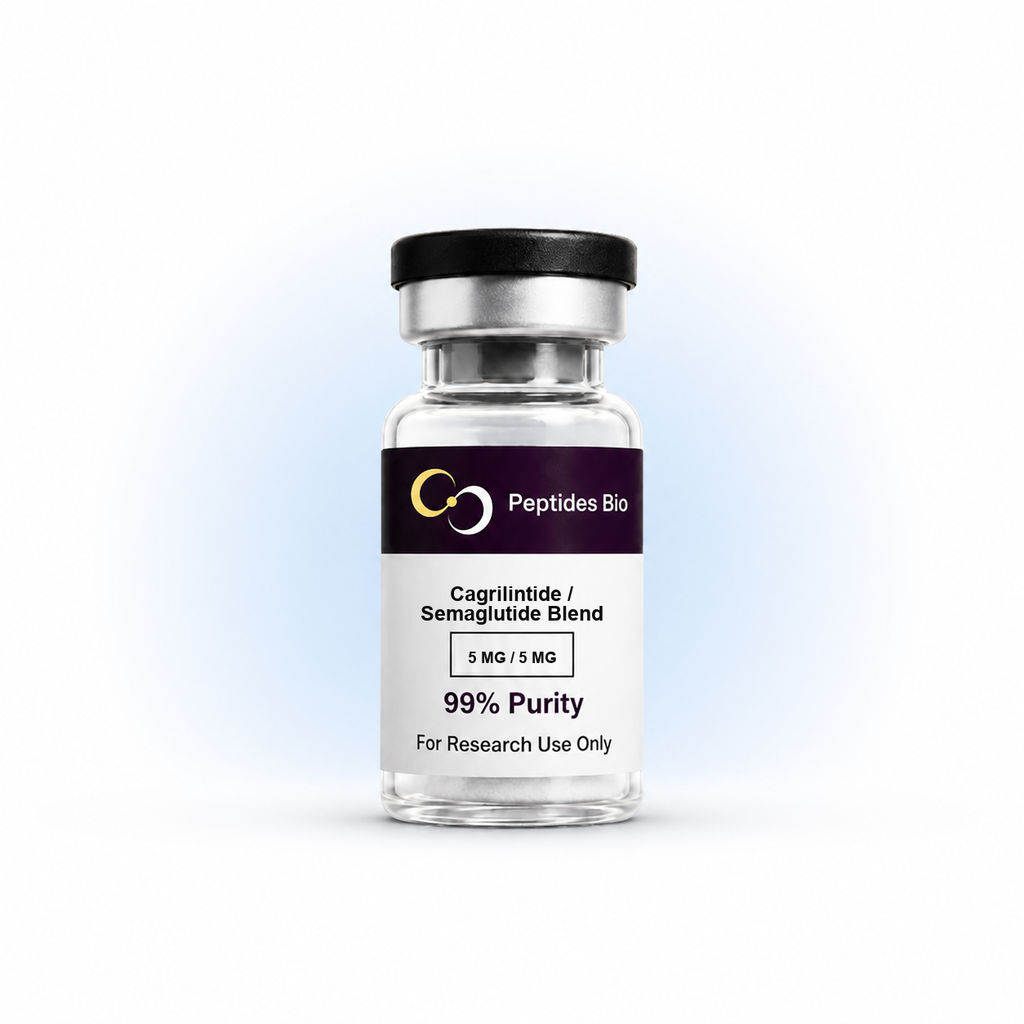
Cagrilintide / Semaglutide Blend (5mg / 5mg)
Important NoticeThis product is for use only in vitro research. It is strictly prohibited for human injection, clinical treatment, food addition or any animal experiments. Please read our terms and conditions carefully before placing an order.
Volume pricing
Configured totals update at each quantity threshold.
Configured total$48.39
Request COA / MSDS
Research record
Pending manual confirmationResearch overview
Cagrilintide is a 37‑amino‑acid synthetic peptide analogue derived from human amylin. It acts as a non‑selective agonist at the pancreatic amylin receptors (AMY1, AMY2, AMY3) and the calcitonin receptor (CTR). Its structure features a Cys²–Cys⁷ disulfide bond—a conserved motif of native amylin essential for receptor binding—and an N‑terminal C18 fatty diacid modification that enables albumin binding, extending its half‑life to approximately 160 hours (6.7 days). Native amylin is a neuroendocrine hormone secreted by pancreatic β‑cells; its physiological actions include delaying gastric emptying, suppressing postprandial glucagon secretion, and promoting satiety. Semaglutide is a long‑acting GLP‑1 receptor agonist with 94% sequence homology to human GLP‑1. Its molecular design includes an Aib (α‑aminoisobutyric acid) substitution and a C18 fatty acid side chain, conferring a half‑life of roughly 168 hours (7 days). Semaglutide stimulates insulin secretion and inhibits glucagon release in a glucose‑dependent manner, while also reducing body weight via central appetite suppression. When combined, cagrilintide and semaglutide target complementary, non‑overlapping pathways: semaglutide acts through the GLP‑1 receptor to delay gastric emptying, inhibit glucagon secretion, and enhance satiety; cagrilintide independently augments satiety, slows gastric emptying, and improves leptin sensitivity, primarily via the pro‑opiomelanocortin (POMC) pathway (leading to melanocortin‑4 receptor activation). When reviewed as a combined research material, the two components should remain analytically distinct. Cagrilintide is studied through amylin and calcitonin receptor systems, while semaglutide is studied through GLP-1 receptor signaling. Literature on one component should not be treated as evidence for the blend, and the material record should preserve component identity, nominal content, lot number and supporting analytical documentation.
Research reference
Product FAQ
What does the 5mg / 5mg designation mean?
It records the nominal pack designation for the cagrilintide and semaglutide components. Confirm the lot specific composition and documentation before making cross source comparisons.
Why should the two components remain separate in a research record?
Cagrilintide is studied through amylin and calcitonin receptor systems, while semaglutide is studied through GLP-1 receptor signaling. Combining their names should not erase those different research contexts.
Can evidence for one component describe the blend?
No. A study of cagrilintide or semaglutide alone does not establish findings for a combined material. Match every claim to the material and method used in the cited source.
Which documents should be requested?
Request the current lot identifier, component record and available identity, purity or composition documentation. The exact document set is confirmed during quotation.
How should the material be recorded?
Use the complete product name, SKU, nominal component amounts, lot number and supporting analytical records.
Data sheet
Manual confirmation- Material Type
- Blend
- Purity Identity
- ≥99% purity
- Molecular Weight
- 4409.01 g/mol/4113.59 g/mol
- Pack Size
- 5mg / 5mg
- Molecular Formula
- C188H289N51O57S2/C187H291N45O59
- CAS Number
- 1415456-99-3/910463-68-2
- PubChem CID
- 171397054/56843331
- Storage conditions overview
- Storage typeLong-termTemperature-80°CDuration2-3 yearsNotesSealed, dark, minimal openingStorage typeStandardTemperature-20°CDuration1-2 yearsNotesSealed, dark, moisture-proofStorage typeShort-termTemperature4°CDuration1-2 weeksNotesTemporary storage, use promptlyStorage typeWorking SolutionTemperature4°CDuration1-7 daysNotesReconstituted, short-term, avoid freeze-thaw