
PEPTIDES BIO / RESEARCH USE POLICY
GHK-Cu: Copper-Complex Source Methods and Documentation Review
A research-use-only review of a defined GHK copper-complex study, its analytical methods, and separate material documentation.
Research or raw-material evaluation only. Not for human or veterinary use.
Related research material
This page brings the GHK-Cu product profile, analytical quality record and published copper-complex research into one practical overview.
GHK-Cu 50 mg gives researchers a clearly identified copper-complex material with a strong analytical profile and published chemistry and wound-model research. The product record and COA for lot GK50-01-905-g387, analysed 20 November 2025, report 99.88% HPLC area purity, 52.27 mg net peptide quantity, conforming retention time, blue-to-off-blue lyophilized powder and endotoxin conforming to ≤0.5 EU/mg.
GHK-Cu 50 mg product summary
| Field | Specification / result | Project value |
|---|---|---|
| Material label | GHK-Cu / Gly-His-Lys-Cu | Clear chemical naming for product and literature searches. |
| Pack size | 50 mg | Useful quantity planning for research workflows. |
| Formula / molecular weight | C14H22CuN6O4 / 401.91 g/mol | Core identifiers for documentation and method planning. |
| HPLC purity | 99.88% area | A strong analytical quality reference reported by the COA. |
| Net peptide quantity | 52.27 mg | Supports concentration and quantity planning. |
| Appearance / endotoxin | Blue-to-off-blue lyophilized powder; endotoxin conforms | Quality-control details available in the product record. |
What the experiments found
Conato et al. examined GHK and two synthetic analogues with potentiometry, solution calorimetry, UV–VIS spectrophotometry, circular dichroism and electron-paramagnetic-resonance spectroscopy. The ligands formed complexes with different stoichiometries and stabilities, with evidence for binuclear species. These findings help researchers understand copper-complex behaviour under defined analytical conditions. See the PubMed record.
In a separate rat wound-chamber experiment, GHK-Cu was associated with concentration-dependent increases in dry weight, DNA, total protein, collagen and glycosaminoglycan content; collagen synthesis was reported as twice that of non-collagen proteins. The study adds a concrete in-vivo research reference to the chemistry profile. See the rat study.
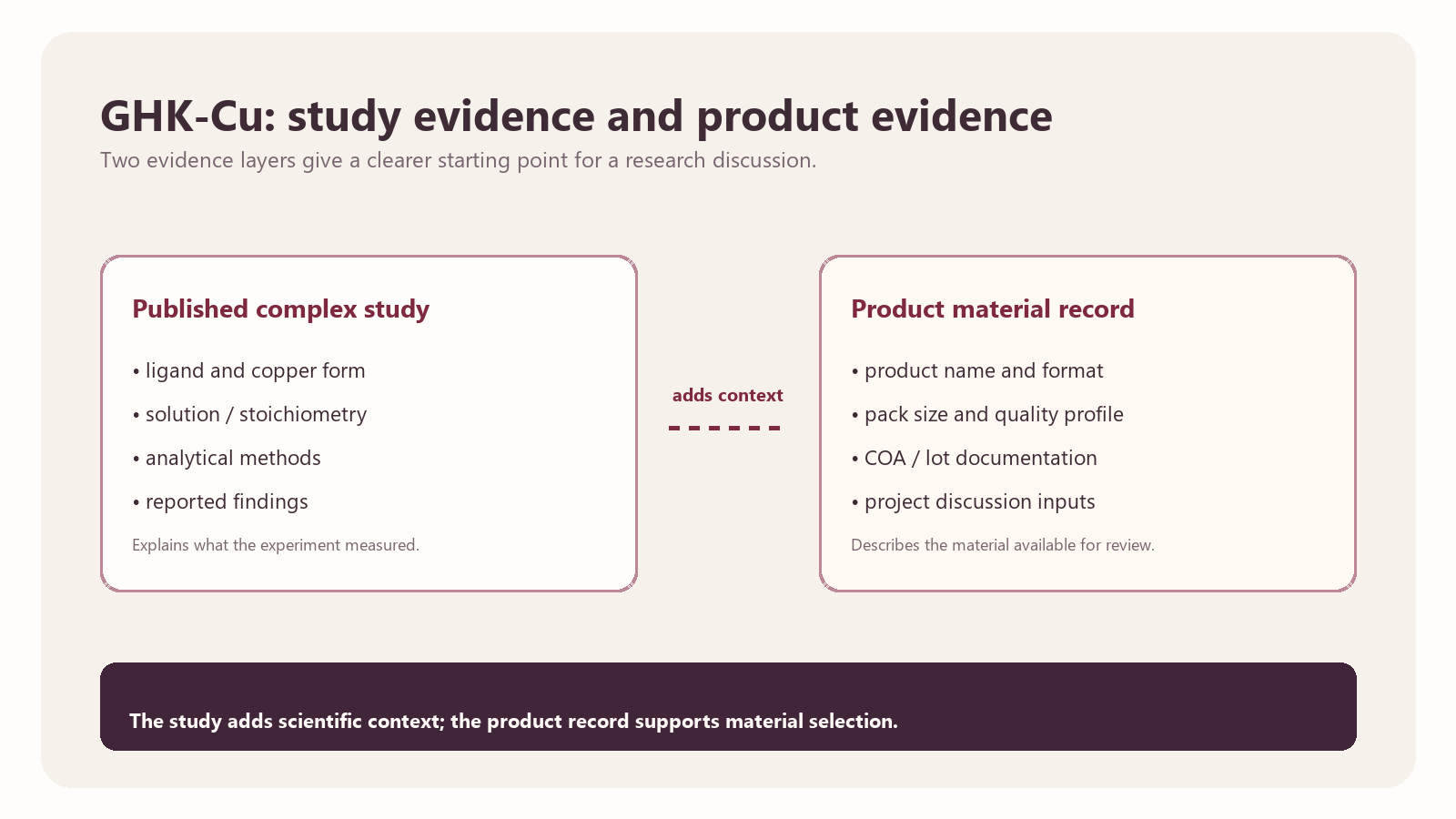
Why this evidence is useful together
- Product record: gives the material name, formula, pack size and analytical profile.
- Chemistry study: adds coordination, stoichiometry and stability context.
- Wound-model study: adds a defined in-vivo research reference.
Planning a GHK-Cu research project
- Define the target model and analytical endpoint before selecting the material format.
- Use the formula, molecular weight and pack size to prepare a clear project brief.
- Link the product profile to the chemistry and wound-model literature when discussing the project.
- Contact the team for pricing, availability and a documentation package.
Next step
Start from the GHK-Cu 50 mg product page, then use the contact page for pricing, availability and a project documentation package. The COA, MSDS and batch-record review is available for teams that want a deeper documentation workflow.
Sources
- Published GHK-Cu 50 mg COA PDF, lot GK50-01-905-g387, analysed 20 November 2025.
- Conato et al., Copper complexes of glycyl-histidyl-lysine and two synthetic analogues, PubMed 11325542.
- In vivo stimulation of connective tissue accumulation by GHK-Cu in rat experimental wounds, PubMed 8227353.
Need a quote, availability check or documentation package? Contact our team with the material name, pack size and project requirements.
References
Need a product record?