
Research Models & Evidence
PEPTIDES BIO / MATERIAL RECORD
GHK-Cu 50mg
Research-use peptide material record: pack format, specifications and COA/SDS request for qualified laboratory review.
RESEARCH USE ONLYRUO
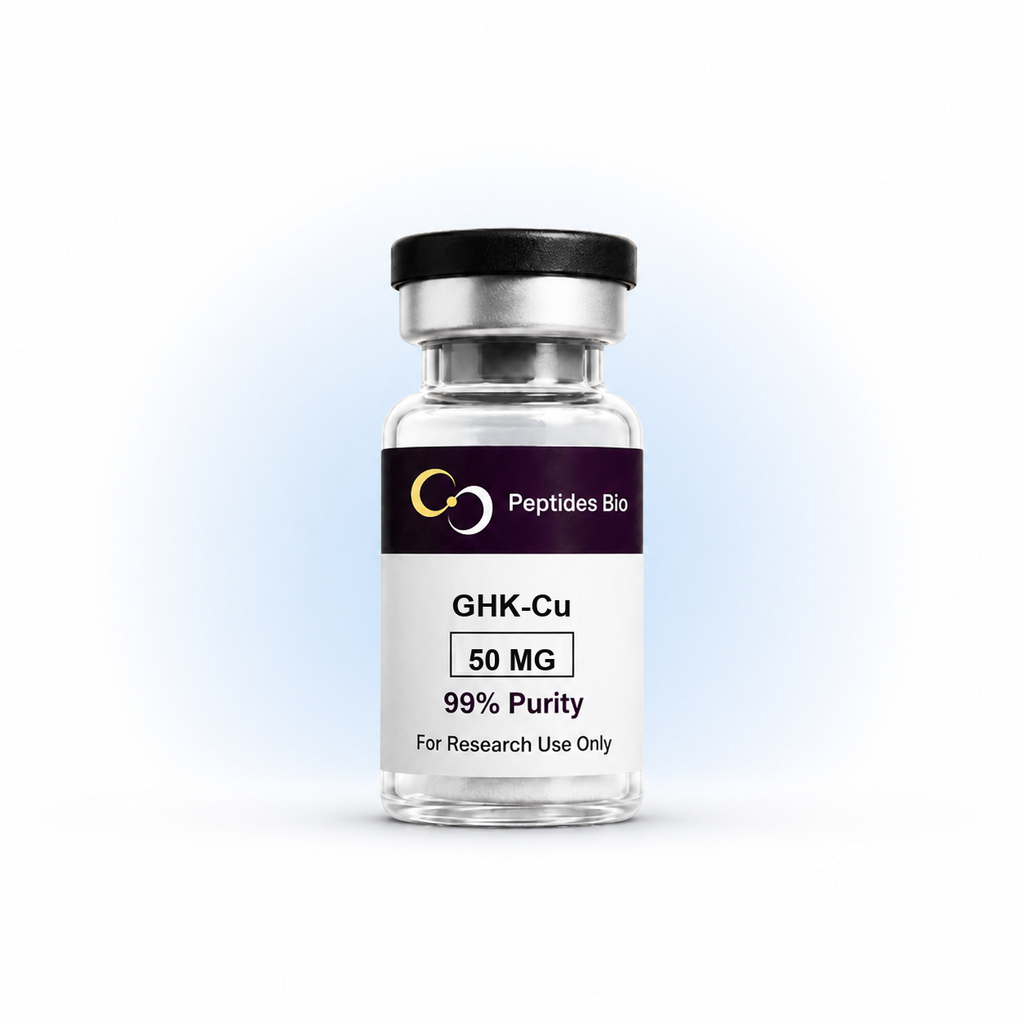
GHK-Cu 50mg
Important NoticeThis product is for use only in vitro research. It is strictly prohibited for human injection, clinical treatment, food addition or any animal experiments. Please read our terms and conditions carefully before placing an order.
Volume pricing
Configured totals update at each quantity threshold.
Configured total$8.14
Request COA / MSDS
Research record
Pending manual confirmationResearch overview
GHK‑Cu (copper peptide, also known as blue copper peptide) is a naturally occurring small‑molecule complex formed by the association of the tripeptide glycine‑histidine‑lysine with copper ions (Cu²⁺). This peptide exhibits remarkable copper‑binding and transport properties. The core mechanism of GHK‑Cu lies in its profound modulation of gene expression—it can influence the activity of thousands of human genes, upregulating those involved in antioxidant defense and tissue repair while downregulating genes associated with inflammation and tissue damage. More specifically, GHK‑Cu stimulates collagen, elastin, and glycosaminoglycan synthesis in fibroblasts, promotes angiogenesis, and suppresses inflammatory responses via downregulation of the JAK1 pathway and reduction of reactive oxygen species (ROS) production. In recent years, it has also shown potential in research on aging‑related cognitive function.
Research reference
Product FAQ
What is GHK‑Cu?
GHK‑Cu (copper peptide) is a naturally occurring tripeptide composed of glycine‑histidine‑lysine (GHK) complexed with a copper ion (Cu²⁺). It is naturally found in human plasma, saliva, and urine, but its concentration decreases significantly with age. GHK‑Cu has been extensively studied for its wound healing, tissue repair, and skin regeneration properties.
What is the mechanism of action of GHK‑Cu?
GHK‑Cu works through multiple mechanisms:
· Copper ion delivery: Delivers copper ions to cells, where copper serves as a cofactor for various enzymes (e.g., superoxide dismutase, lysyl oxidase)
· Gene expression modulation: GHK‑Cu has been shown to modulate the expression of over 4,000 human genes
· Anti‑inflammatory effects: Suppresses the production of pro‑inflammatory factors (TNF‑α, IL‑1β, IL‑6)
· Promoting cell migration and proliferation: Enhances fibroblast and keratinocyte migration and proliferation, accelerating wound closure
· Antioxidant effects: Reduces ROS production and protects cells from oxidative stress
Is GHK‑Cu a banned substance?
GHK‑Cu is not currently listed on the WADA Prohibited List. It has a distinct mechanism of action and is not considered a growth hormone releaser or performance enhancer
Does GHK‑Cu have research value for hair growth?
Yes. Studies show that GHK‑Cu promotes hair follicle stem cell proliferation, increases follicle diameter and the anagen/telogen ratio in vitro. Topical application of GHK‑Cu has demonstrated hair regeneration and increased follicle counts in animal models, making it potentially valuable in androgenetic alopecia research.
What are the main research areas for GHK‑Cu?
· Skin wound healing and scar repair
· Anti‑aging and skin regeneration
· Hair growth and follicle repair
· Anti‑inflammation and antioxidant effects
· Nervous system protection
· Cancer research
· Tissue angiogenesis (blood vessel formation)
Data sheet
Manual confirmation- Material Type
- Single material
- Purity Identity
- ≥99% purity
- Molecular Weight
- 401.91 g/mol
- Pack Size
- 50mg
- Molecular Formula
- C14H22CUN6O4
- CAS Number
- 89030-95-5
- Amino Acid Sequence
- Gly-His-Lys-Cu
- PubChem CID
- 71587328
- Storage conditions overview
- Storage typeLong-termTemperature-80°CDuration2-3 yearsNotesSealed, dark, minimal openingStorage typeStandardTemperature-20°CDuration1-2 yearsNotesSealed, dark, moisture-proofStorage typeShort-termTemperature4°CDuration1-2 weeksNotesTemporary storage, use promptlyStorage typeWorking SolutionTemperature4°CDuration1-7 daysNotesReconstituted, short-term, avoid freeze-thaw
Related research guides
Review before you request.
Quality & Documentation
GHK-Cu: A Copper-Tripeptide Research Guide
A GHK-Cu research guide covering copper-tripeptide terminology, literature context, and the boundary between sources and batch records.Read guideResearch Use Policy
GHK-Cu: Copper-Complex Source Methods and Documentation Review
A research-use-only review of a defined GHK copper-complex study, its analytical methods, and separate material documentation.Read guideProcurement & Quotes
Peptide Purity Testing Cost: Normalize a Public Quote
A quote-normalization ledger for peptide purity testing cost searches, using peptide-focused core-facility rates to separate analytical HPLC, LCMS, mass determination, preparation, customer category, units, and missing fields.Read guideQuality & Documentation
Lyophilized Research Peptide: Form Labels to Record Fields
A form-label to record-field guide for lyophilized research peptide pages, labels, containers, lots, and analytical files, without treating lyophilized status as identity or quality proof.Read guideQuality & Documentation
Peptide Certificate of Analysis: A Coherence Audit
A certificate coherence audit for peptide records, testing six joins among the displayed issuer field, material, lot, method/result/unit, dates/version, and stated limits without converting a certificate into a universal quality claim.Read guideResearch Models & Evidence
GHK-Cu Research Paper: A Claim-to-Method Audit
A claim-to-method audit of one open-access GHK-Cu original paper, mapping its material fields, mouse subsets, A549 cell system, methods, figures, missing fields, and conclusion limits.Read guideResearch Models & Evidence