
Research Use Policy
PEPTIDES BIO / MATERIAL RECORD
PT-141 (Bremelanotide) 10mg
Research-use peptide material record: pack format, specifications and COA/SDS request for qualified laboratory review.
RESEARCH USE ONLYRUO
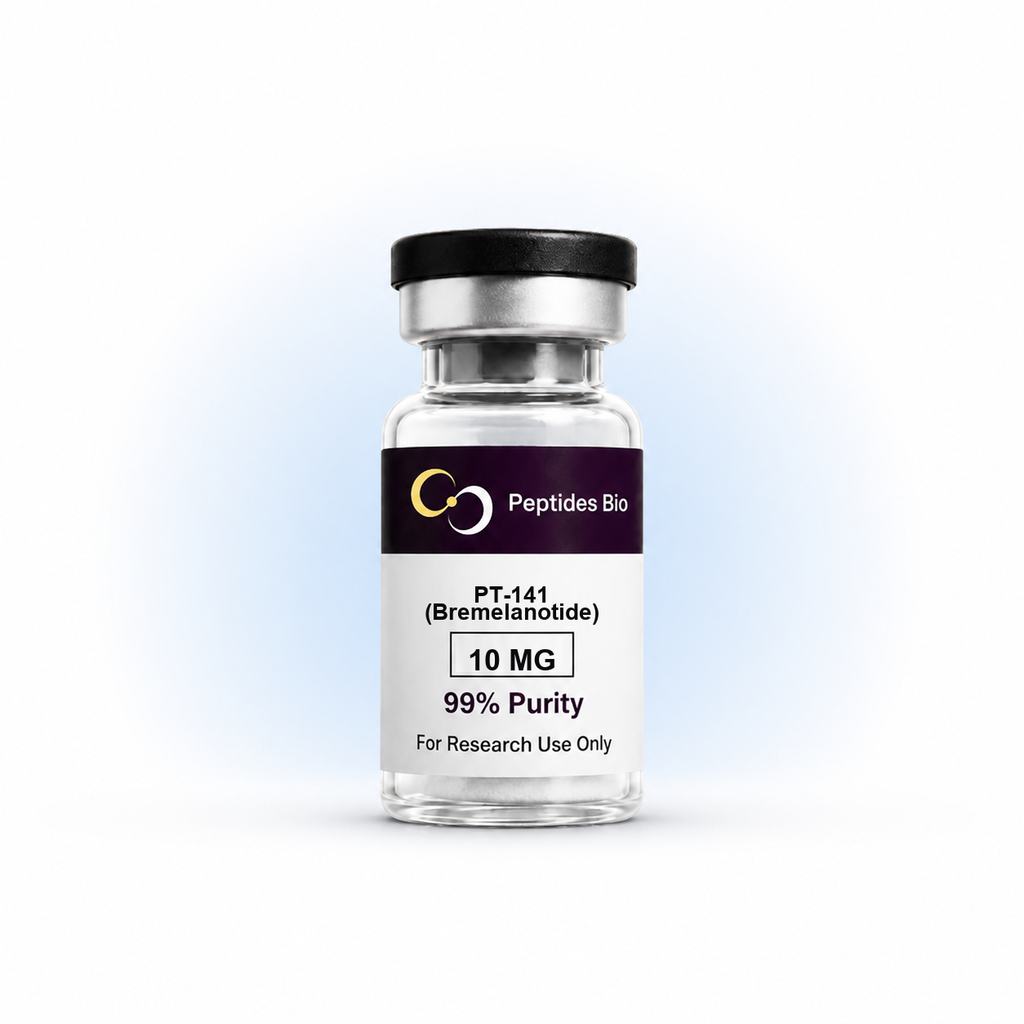
PT-141 (Bremelanotide) 10mg
Important NoticeThis product is for use only in vitro research. It is strictly prohibited for human injection, clinical treatment, food addition or any animal experiments. Please read our terms and conditions carefully before placing an order.
Volume pricing
Configured totals update at each quantity threshold.
Configured total$22.90
Request COA / MSDS
Research record
Pending manual confirmationResearch overview
PT‑141 (Bremelanotide, also known as bremanotide) is a cyclic synthetic heptapeptide (7 amino acids) and a peptide analogue of endogenous α‑melanocyte‑stimulating hormone (α‑MSH). As a melanocortin receptor agonist, PT‑141 activates MC3R and MC4R—the primary receptor subtypes expressed in the central nervous system—thereby increasing dopamine release. This mechanism acts centrally on pathways that regulate sexual desire and response, rather than through the peripheral vascular system. Based on this mechanism, PT‑141 was approved by the FDA in 2019 (trade name Vyleesi®) for the treatment of hypoactive sexual desire disorder (HSDD) in premenopausal women. In addition, clinical studies have also suggested potential applications in the treatment of male erectile dysfunction.
Research reference
Product FAQ
What is PT-141 (Bremelanotide)?
PT-141 (Bremelanotide) is a synthetic cyclic heptapeptide and a structural analogue of Melanotan II. It works by activating melanocortin receptors (primarily MC1R and MC4R). Unlike Melanotan II, PT-141 has been structurally optimized to significantly reduce skin pigmentation (tanning) effects while retaining MC4R activation, so its primary research focus is on sexual dysfunction and CNS modulation rather than tanning.
What is the mechanism of action of PT-141?
PT-141 works by activating melanocortin receptors (primarily MC4R and MC1R). In the central nervous system, MC4R activation is believed to be involved in regulating libido and sexual response—this is the primary mechanism by which PT-141 improves sexual dysfunction. Unlike sildenafil (a PDE5 inhibitor that works through vasodilation), PT-141 acts directly on the central nervous system to enhance sexual desire and response in the presence of sexual stimuli, making it useful for patients who do not respond to or cannot tolerate PDE5 inhibitors.
Does PT-141 cause dependence?
There is currently no evidence that PT-141 is addictive or causes drug dependence. As a centrally acting agent, it does not act on the dopamine system in the reward pathway (the system associated with addiction) and does not produce euphoria. However, long-term use and dependence data are still limited, and use is recommended only in research settings.
What are the main research areas for PT-141?
· Hypoactive sexual desire disorder (HSDD) in women
· Erectile dysfunction (ED) in men
· Libido regulation
· Central nervous system modulation
· Mood and affective disorders
Data sheet
Manual confirmation- Material Type
- Single material
- Purity Identity
- ≥99% purity
- Molecular Weight
- 1025.18 g/mol
- Pack Size
- 10mg
- Molecular Formula
- C50H68N14O10
- CAS Number
- 189691-06-3
- Amino Acid Sequence
- Nle-D(1)HFRWK(1); Ac-Nle-Asp(1)-His-D-Phe-Arg-Trp-Lys(1)-OH
- PubChem CID
- 9941379
- Storage conditions overview
- Storage typeLong-termTemperature-80°CDuration2-3 yearsNotesSealed, dark, minimal openingStorage typeStandardTemperature-20°CDuration1-2 yearsNotesSealed, dark, moisture-proofStorage typeShort-termTemperature4°CDuration1-2 weeksNotesTemporary storage, use promptlyStorage typeWorking SolutionTemperature4°CDuration1-7 daysNotesReconstituted, short-term, avoid freeze-thaw