
PEPTIDES BIO / QUALITY & DOCUMENTATION
BPC-157: Literature-Record Scope and Documentation Review
A research-use-only review of BPC-157 source scope, narrative-review limits, and separate documentation for received materials.
Research or raw-material evaluation only. Not for human or veterinary use.
Related research material
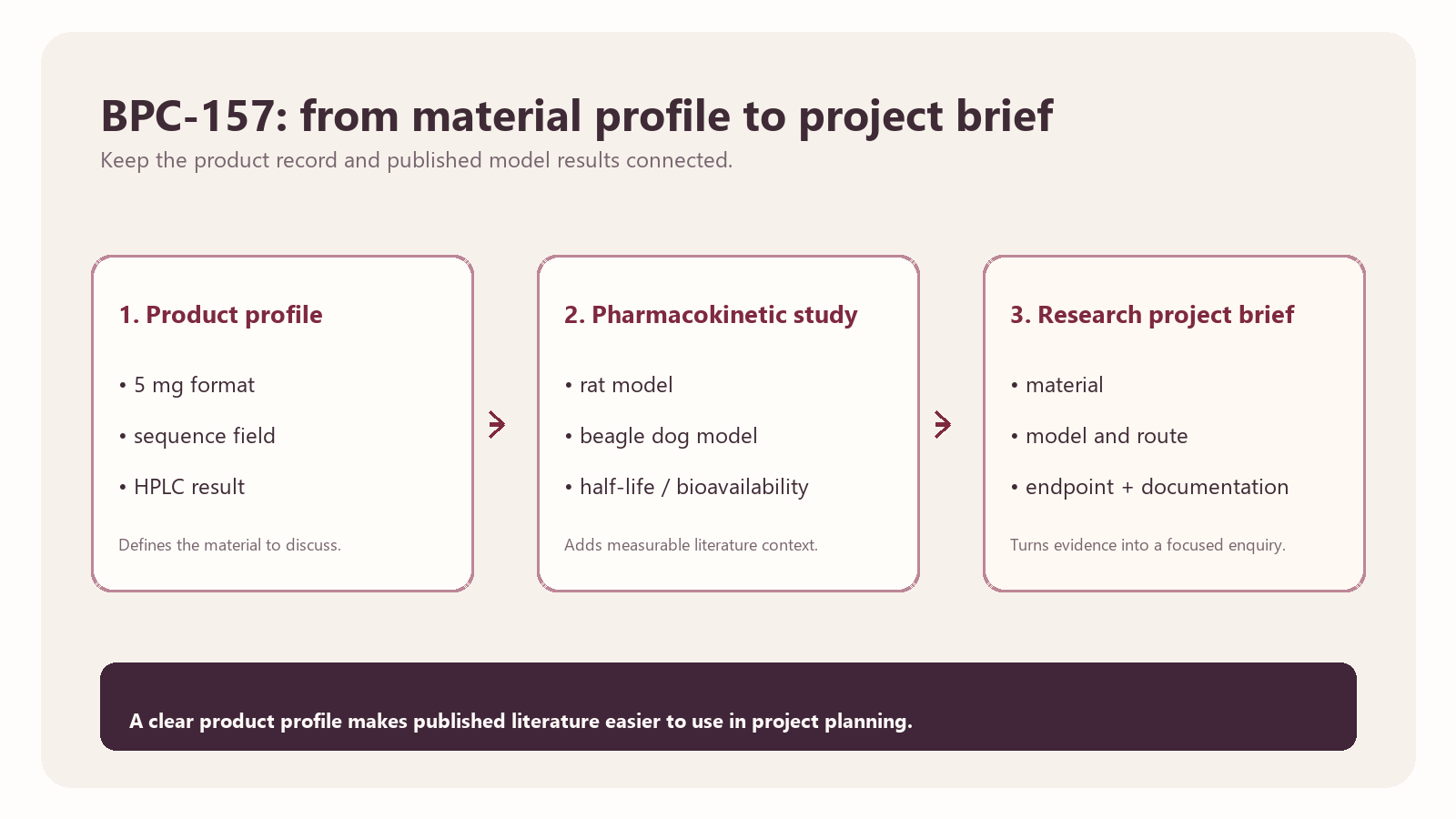
This page brings the BPC-157 product profile, analytical quality record and published pharmacokinetic research into one practical overview.
BPC-157 5 mg combines a defined lyophilized format with a clear analytical profile and published pharmacokinetic research in rats and beagle dogs. The product record and COA for lot BP05-01-625-b112, analysed 28 July 2025, report 99.01% HPLC area purity, 5.77 mg net peptide quantity, conforming retention time, white-to-off-white lyophilized powder and endotoxin conforming to ≤0.5 EU/mg.
BPC-157 5 mg product summary
| Field | Specification / result | Project value |
|---|---|---|
| Pack size | 5 mg | Useful quantity planning for screening and method development. |
| Sequence-style field | Gly-Glu-Pro-Pro-Pro-Gly-Lys-Pro-Ala-Asp-Asp-Ala-Gly-Leu-Val | Core sequence wording for product and literature searches. |
| Molecular weight | 1419.53 g/mol | A key identifier for documentation and method planning. |
| HPLC purity | 99.01% area | A clear analytical quality reference reported by the COA. |
| Net peptide quantity | 5.77 mg | Supports concentration and quantity planning. |
| Appearance / endotoxin | White-to-off-white lyophilized powder; endotoxin conforms | Quality-control details available in the product record. |
What a published experiment found
A 2022 pharmacokinetic study examined BPC-157 in rats and beagle dogs. The reported elimination half-life was less than 30 minutes; mean absolute bioavailability after intramuscular administration was approximately 14–19% in rats and 45–51% in beagle dogs, and the labelled compound was rapidly metabolised into smaller peptide fragments. These results give researchers concrete pharmacokinetic reference points for literature review and project planning. See the PubMed record.
The product record and pharmacokinetic paper work well together: one describes the material profile, while the other gives measurable results from defined animal models and an experimental protocol.
How this literature supports project planning
- Material: Start with the 5 mg format, sequence wording and analytical profile.
- Model: Match the rat or beagle-dog findings to the research question.
- Method: Keep dose route, endpoint and pharmacokinetic metric together.
- Next step: Contact the team for pricing, availability and a documentation package.
Next step
Explore the BPC-157 5 mg product page for product details, then use the contact page for pricing, availability and a project documentation package. The COA, MSDS and batch-record review is available for teams that want a deeper documentation workflow.
Sources
- Published BPC-157 5 mg COA PDF, lot BP05-01-625-b112, analysed 28 July 2025.
- Pharmacokinetics, distribution, metabolism, and excretion of BPC-157 in rats and dogs, PubMed 36588717.
Need a quote, availability check or documentation package? Contact our team with the material name, pack size and project requirements.
References
Need a product record?