
PEPTIDES BIO / PEPTIDE IDENTITY & STRUCTURE
Cagrilintide Research Peptide: Name and Record Boundaries
An identity-boundary audit for cagrilintide research peptide names, PubChem Compound/Substance records, and catalogue-to-lot joins.
Research or raw-material evaluation only. Not for human or veterinary use.
Cagrilintide 10 mg combines a defined lyophilized format with a clear analytical record and published mechanism research. The product record and COA for lot CG10-01-812-w762, analysed 26 August 2025, report 99.96% HPLC area purity, 12.83 mg net peptide quantity, conforming retention time, white-to-off-white lyophilized powder and endotoxin conforming to ≤0.5 EU/mg. Together with the published mouse study below, these details give researchers a practical starting point for material selection and study planning.
Cagrilintide 10 mg product summary
| Field | Specification / result | Project value |
|---|---|---|
| Pack size | 10 mg | Clear quantity planning for screening and method development. |
| Material form | White-to-off-white lyophilized powder; conforms | Defines the material form for project planning. |
| HPLC purity | 99.96% area | A strong analytical quality reference reported by the COA. |
| Net peptide quantity | 12.83 mg | Supports concentration and quantity planning. |
| Retention time | Conforms to the stated ±0.2 min specification | Confirms the chromatographic result reported in the COA. |
| Endotoxin | Conforms to ≤0.5 EU/mg | Included as a quality-control checkpoint in the COA. |
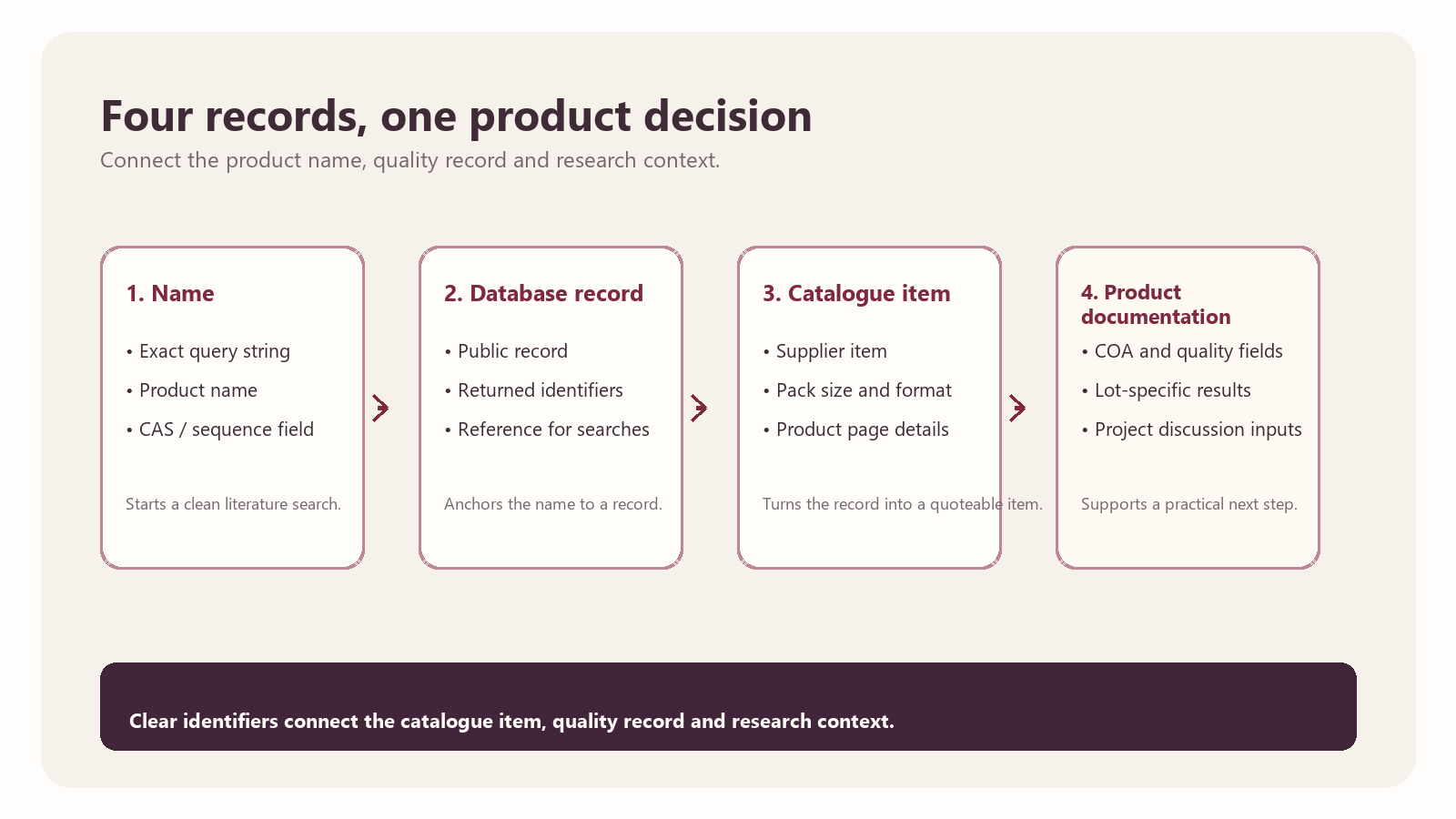
The product record also lists molecular formula C194H312N54O59S2, molecular weight 4409.01 g/mol, CAS 1415456-99-3, and a sequence-style field, giving researchers the core identifiers needed for literature searches, quotations and project documentation.
What published experiments are actually showing
Published research adds useful context to the material record. In one receptor-mechanism study, male high-fat-diet wild-type mice received 3 nmol/kg subcutaneously once daily for three weeks. The cagrilintide group lost 3.4 ± 0.51 g of body weight (n=8 per group). On day 1, food intake was 1.2 ± 0.1 g versus 2.7 ± 0.2 g with vehicle. Removing RAMP1 and RAMP3 reduced cagrilintide potency, which is why the authors linked the effect to AMY1R and AMY3R pathways. See the PubMed record.
Clinical trial results for cagrilintide or cagrilintide combinations add further context on participants, formulation, dose, monitoring and endpoints. This page brings the material record and published research together so a team can move faster from product selection to a focused project discussion.
Why researchers use this information
- Material selection: Start with a defined 10 mg lyophilized format and a documented analytical profile.
- Project planning: Use purity, net quantity and molecular identifiers to structure a method or screening discussion.
- Literature alignment: Connect the product record with receptor, pathway and animal-model findings.
- Next step: Move directly to a quote, availability check or documentation package through the product and contact pages.
Next step
Explore the Cagrilintide 10 mg product page for pack size and product details, then use the contact page for pricing, availability and a project documentation package. You can also review the COA, MSDS and batch-record review for a deeper documentation workflow.
Sources
- Published Cagrilintide 10 mg COA PDF, lot CG10-01-812-w762, analysed 26 August 2025.
- Cagrilintide lowers bodyweight through brain amylin receptors 1 and 3, PubMed 40609154.
Need a quote, availability check or documentation package? Contact our team with the material name, pack size and project requirements.
References
Need a product record?