
Peptide Identity & Structure
PEPTIDES BIO / MATERIAL RECORD
SS-31 10mg
Research-use peptide material record: pack format, specifications and COA/SDS request for qualified laboratory review.
RESEARCH USE ONLYRUO
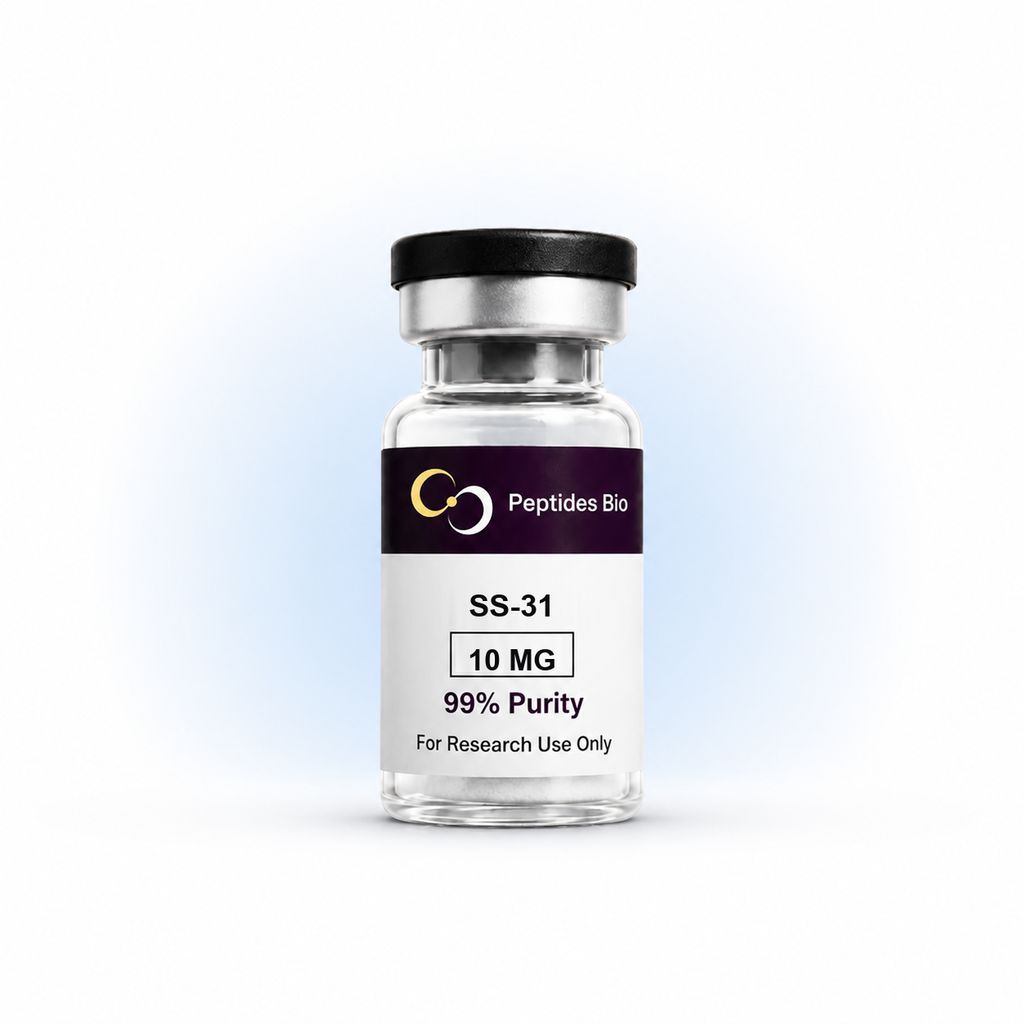
SS-31 10mg
Important NoticeThis product is for use only in vitro research. It is strictly prohibited for human injection, clinical treatment, food addition or any animal experiments. Please read our terms and conditions carefully before placing an order.
Volume pricing
Configured totals update at each quantity threshold.
Configured total$29.78
Request COA / MSDS
Research record
Pending manual confirmationResearch overview
SS‑31, officially known as Elamipretide or MTP‑131, is a synthetic tetrapeptide composed of four amino acids. Unlike conventional free‑radical scavengers, SS‑31 is a mitochondria‑targeted peptide that selectively accumulates in the inner mitochondrial membrane. Its primary molecular target is cardiolipin—a phospholipid found almost exclusively in the inner mitochondrial membrane. By specifically binding to cardiolipin, SS‑31 stabilizes mitochondrial cristae architecture, preserves the integrity of the respiratory chain, reduces mitochondrial reactive oxygen species (ROS) production, and enhances ATP synthesis. In contrast to ordinary antioxidants that directly scavenge free radicals, SS‑31 attenuates oxidative damage at its source by repairing the mitochondrial membrane structure.
Research reference
Product FAQ
What is SS-31?
A mitochondria‑targeting tetrapeptide (also known as Elamipretide, MTP‑131, Bendavia) that stabilizes mitochondrial structure by binding to cardiolipin on the inner mitochondrial membrane, reducing ROS production and enhancing ATP synthesis.
What is the mechanism of action of SS‑31?
SS‑31 selectively accumulates in the inner mitochondrial membrane, binds to cardiolipin, stabilizes cristae structure, inhibits cytochrome c peroxidase activity, and reduces oxidative damage. It also inhibits mitochondrial permeability transition pore opening, increases ATP synthesis, and exhibits anti‑inflammatory effects.
Is there clinical research supporting SS‑31?
Yes. In 2025, SS‑31 received FDA accelerated approval for Barth syndrome, a rare mitochondrial disease. It is also in clinical trials for multiple indications including heart failure, kidney injury, and ophthalmic diseases.
How does SS‑31 differ from common antioxidants?
Traditional antioxidants like Coenzyme Q10 and MitoQ do not specifically target mitochondrial membrane components. SS‑31 precisely targets the inner mitochondrial membrane by binding to cardiolipin, achieving 1000‑5000‑fold accumulation in mitochondria with high specificity.
What are the main research areas for SS‑31?
Research covers a wide range of areas, including:
· Neurodegenerative diseases (Parkinson's, Alzheimer's, etc.)
· Cardiovascular diseases (myocardial infarction, ischemia‑reperfusion injury, heart failure)
· Aging and age‑related diseases (muscle aging, osteoarthritis)
· Kidney diseases (acute kidney injury)
· Ophthalmic diseases (glaucoma)
· Female reproductive aging (improving aged oocyte quality)
· Barth syndrome (FDA accelerated approval granted)
Data sheet
Manual confirmation- Material Type
- Single material
- Purity Identity
- ≥99% purity
- Molecular Weight
- 639.79 g/mol
- Pack Size
- 10mg
- Molecular Formula
- C32H49N9O5
- CAS Number
- 736992-21-5
- Amino Acid Sequence
- H-D-Arg-Tyr(2,6-diMe)-Lys-Phe-NH2
- PubChem CID
- 11764719
- Storage conditions overview
- Storage typeLong-termTemperature-80°CDuration2-3 yearsNotesSealed, dark, minimal openingStorage typeStandardTemperature-20°CDuration1-2 yearsNotesSealed, dark, moisture-proofStorage typeShort-termTemperature4°CDuration1-2 weeksNotesTemporary storage, use promptlyStorage typeWorking SolutionTemperature4°CDuration1-7 daysNotesReconstituted, short-term, avoid freeze-thaw
Related research guides
Review before you request.
Quality & Documentation
How to Read a Peptide HPLC Record: A Document-Version Audit
A research-material documentation guide for reading a peptide HPLC record as a traceable document rather than a standalone quality claim.Read guideQuality & Documentation
Third-Party Reports and Batch Traceability: Document Boundaries
A source-limited guide to the document, version, sample, and batch boundaries of third-party reports for research materials.Read guideProcurement & Quotes
Preparing a multi-item quote request
A practical guide to preparing a clear multi-item peptide research-material quote request.Read guideLaboratory Records
Receiving, labels & laboratory records
A receiving and labelling guide that keeps peptide research materials, supporting documents, and internal records connected.Read guideResearch Use Policy
Research Use Only: scope & boundaries
A guide to research-use boundaries for peptide literature, product records, and laboratory documentation.Read guideQuality & Documentation
Reviewing COA, MSDS & batch records
A practical guide to reviewing COA, SDS or MSDS, and batch records for peptide research materials.Read guideLaboratory Records
Storage & handling records
A documentation guide for storage and handling records that support traceable peptide research-material review.Read guideQuality & Documentation
What is confirmed manually
A guide to the product, document, batch, and commercial details that require manual confirmation for research materials.Read guideProcurement & Quotes
Peptide Research Supplies: Category Labels and Record Boundaries
A category-label to item-record boundary guide for peptide research supplies, separating website classification wording from catalogue identity, receiving labels, lot links, and document fields.Read guideProcurement & Quotes
Research Peptides Online: Trace the Listing Record Chain
A provenance-chain guide for online research peptide listings, separating a captured webpage, RDAP domain response, HTTPS connection observation, registry output, catalogue item, and lot-specific material record.Read guidePeptide Identity & Structure
Cagrilintide Research Peptide: Name and Record Boundaries
An identity-boundary audit for cagrilintide research peptide names, PubChem Compound/Substance records, and catalogue-to-lot joins.Read guideProcurement & Quotes
Research Peptide Suppliers: An Evidence-Led Evaluation Framework
An evidence-led framework for comparing research peptide supplier records by identity, lot traceability, document control, and verifiable laboratory roles.Read guideQuality & Documentation
Peptide Purity Testing: A Declaration-First Evidence Matrix
A declaration-first framework separating chromatographic purity from identity, assay/content, related substances, water, counterion, residuals, stability, and biological activity evidence.Read guideLaboratory Records
Peptide Purity Testing Lab: Sample Paths and Report Limits
A sample-path audit of peptide purity testing lab pages, separating user-sample analysis, core products, peptide-library sampling, and report limits.Read guideLaboratory Records
Research Peptide Testing Lab: Scope and Record Boundaries
How to audit a research peptide testing lab page by service scope, sample handoff, method labels, report fields, and the limits of capability claims.Read guidePeptide Identity & Structure
CJC-1295 Research Peptide: Name and Record Boundaries
An identity-boundary audit for CJC-1295 names, PubChem Compound/Substance records, PubMed citations, and catalogue-to-lot joins.Read guidePeptide Identity & Structure
GHK-Cu Research Grade: Identity and Record Boundaries
A GHK-Cu research grade audit that separates category wording, GHK ligand records, copper-complex candidates, analytical files, and lot connections.Read guidePeptide Identity & Structure
BPC-157 Research Grade: Label Evidence and Record Limits
A record audit for the phrase BPC-157 research grade, separating category wording, identity fields, analytical statements, lot links, and use boundaries.Read guidePeptide Identity & Structure
TB-500 Research Peptide: Name-to-Record Identity Audit
An identity-chain audit for TB-500 research peptide labels, separating market wording, thymosin beta-4 records, fragments, entities, catalogues, and lots.Read guidePeptide Identity & Structure
Peptide Research Chemicals: Five Identity Records
A naming-record guide for peptide research chemicals, separating peptide descriptions, seller categories, catalogue items, PubChem identities, and lot-specific material files without assigning a universal grade.Read guideQuality & Documentation